Mechanism, Results and the Role of Facial Muscles
Tension headaches are one of the most common types of headaches, affecting millions of people every year. For many individuals, the pain can feel like a constant pressure around the forehead, temples, scalp, or back of the head. While medication may provide temporary relief, many people are looking for natural ways to address the underlying causes of their discomfort.
One treatment that is becoming increasingly popular is Kobido face and head massage. By working deeply on the facial muscles, scalp, jaw, and neck, it may help reduce the muscle tension that often contributes to tension headaches.
If you live in London and regularly experience headaches linked to stress, screen time, poor posture, or jaw clenching, Kobido may offer a valuable addition to your wellness routine.
What Are Tension Headaches?
Tension headache is typically caused by muscle tension and stress rather than an underlying medical condition. is the most common type of "everyday" headache, classically described as a constant, dull ache that feels like a tight band or vice squeezing around both sides of the head.
Often described as:
- Pressure behind the eyes
- Tenderness in the scalp
- Tightness in the neck and shoulders
- Pain around the temples
Unlike migraines, tension headaches are not usually associated with nausea or visual disturbances. However, they can still significantly impact quality of life.
Many sufferers do not realise that the muscles of the face and jaw often play a major role in triggering these headaches.
How Facial Muscles Contribute to Tension Headaches
The face contains numerous muscles that are active throughout the day. Every time you smile, frown, squint, chew, or speak, these muscles are working.
When stress levels rise, many people unconsciously create tension in areas such as:
- The forehead
- The temples
- The jaw
- Around the eyes
- The scalp
- The neck
Over time, these muscles can become overactive and remain in a partially contracted state.
Common examples include:
Jaw Clenching
Many people clench their jaw during stressful situations or while concentrating at work. This can create tension that radiates into the temples and head.
Forehead Tension
Constant frowning, concentrating, or screen use may contribute to tension in the forehead muscles.
Tight Temple Muscles
The temporalis muscles, located at the sides of the head, are often involved in both jaw tension and headaches.
Neck and Scalp Tightness
Poor posture and prolonged desk work can create tension patterns that extend from the neck into the scalp and forehead.
The Mechanism: How Kobido May Help Tension Headaches
Understanding how Kobido works helps explain why many clients experience relief from facial tension and headache symptoms.
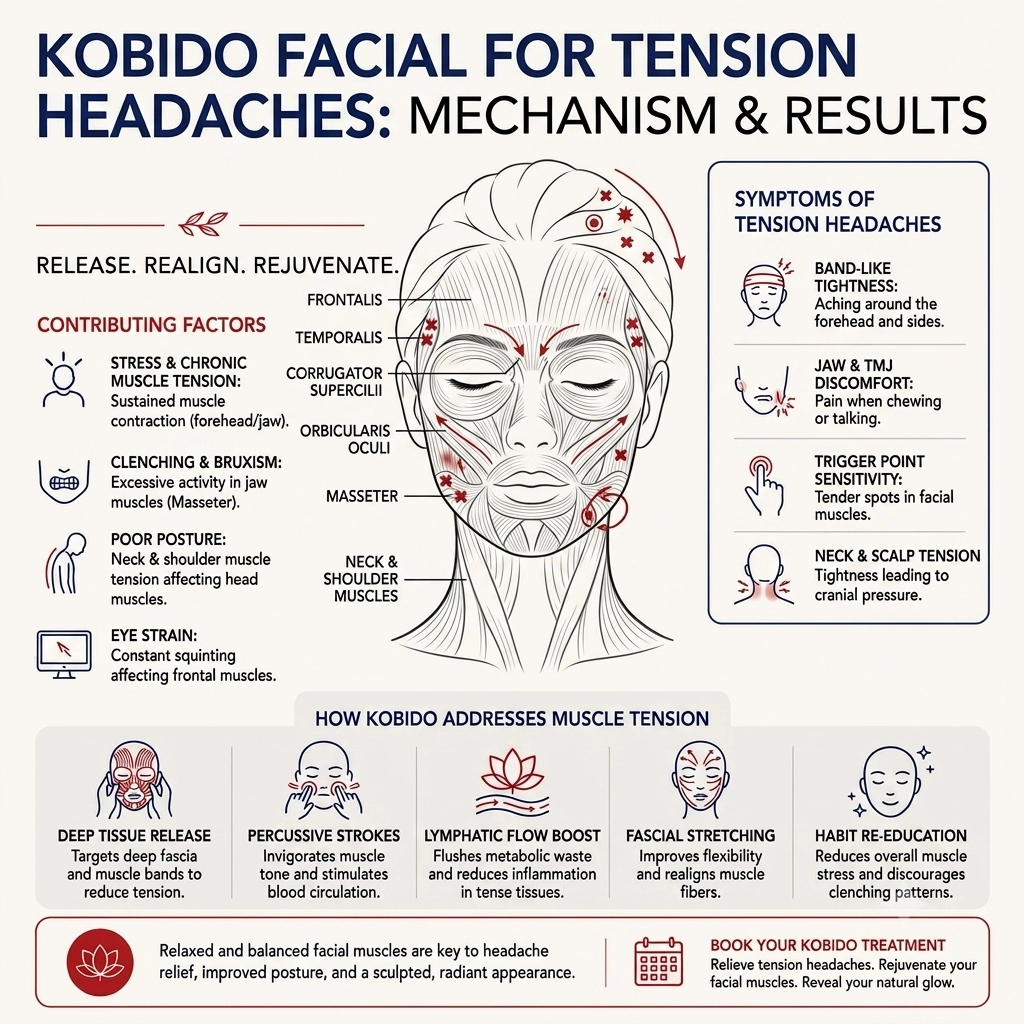
1. Releasing Muscle Tension
One of the primary mechanisms behind Kobido is the release of tightness all over the head muscles.
Massaging primary chewing muscles, like the masseter and temporalis, relieves headaches through several specific mechanisms.
The treatment focuses on areas commonly associated with headache development, including:
Frontalis Belly: The muscle section located at the front, covering your forehead. It raises your eyebrows and wrinkles your forehead.
Occipitalis Belly: The muscle section located at the back of the head, near the base of the skull. It pulls the scalp backwards.
Epicranial Aponeurosis (Galea Aponeurotica): The wide, flat tendon layer that runs over the top of the skull, connecting the front and back muscle bellies together.
By encouraging these muscles to relax, Kobido may help reduce the physical tension contributing to headache symptoms.
It is an effective, strong therapy for muscle and tissue release. The practitioner relaxes tight muscles in the neck and focuses on releasing tension in the Epicranius muscle in this entire interconnected structure to reduce pressure around the skull.
2. Improving Blood Circulation
Tight muscles can restrict healthy circulation.
Kobido stimulates blood flow throughout the face and scalp, helping to:
- Deliver oxygen to tissues
- Remove metabolic waste products
- Support muscle recovery
- Promote a healthier appearance
Improved circulation often contributes to a feeling of lightness and relief.
3. Reducing Jaw Tension
Many tension headaches are linked to jaw clenching and teeth grinding.
Stopping Referred Pain Pathways
When jaw muscles are overworked from stress, clenching, or teeth grinding (bruxism), they develop hyper-irritable spots called trigger points.
- The Masseter Muscle: Located at the side of your jaw, tightening this muscle triggers referred pain that travels upward, mimicking a throbbing tension headache along your brow, cheeks, or upper teeth.
- The Temporalis Muscle: This broad muscle sits directly on the side of your skull at your temples. Because it connects directly to your jaw, jaw tension causes the temporalis to lock up, creating a literal "vice-like" grip around your head. Massage manually deactivates these trigger points to break the pain loop.
Decompressing the Temporomandibular Joint (TMJ)
Constant jaw clenching forces the jaw joint (TMJ) backwards and upward, compressing local nerves and blood vessels. Massage therapy reduces this upward mechanical pressure, increasing joint mobility and clearing away localised inflammation that contributes to chronic facial and head pain.
Calming the Trigeminal Nerve System
The jaw muscles are controlled by the trigeminal nerve, which is the primary sensory pathway responsible for head and facial pain. When jaw muscles are chronically tight, they constantly overstimulate this nerve pathway. Gentle, rhythmic massage works as a counter-stimulus, lowering your central nervous system's stress signals and desensitising the nerve pathways that trigger tension headaches and migraines.
Releasing Interconnected Neck and Scalp Muscles
The human body is connected by sheets of connective tissue (fascia). The muscles that pull your jaw shut work in tandem with the suboccipital muscles at the very base of your skull to keep your head balanced. Massaging the jaw immediately unloads tension in your neck, preventing neck stiffness from travelling upward into a cervicogenic or tension headache.
4. Supporting the Nervous System
Face and head massage supports the nervous system by acting as a powerful down-switch for the body's autonomic nervous system, moving it away from a stress response and directly activating relaxation pathways. Because the scalp, face, and jaw are packed with dense networks of sensitive cranial nerves, manual therapy in these areas directly signals the brain that the body is safe.
- Activating the Parasympathetic Nervous System
Chronic stress keeps the body locked in the sympathetic nervous system ("fight or flight"). Face and head massage stimulates the parasympathetic nervous system ("rest and digest"). This shift immediately slows down your breathing, lowers circulating cortisol (the primary stress hormone), and prompts your blood vessels to dilate, allowing oxygen and nutrients to flow easily to the brain.
- Stimulating the Vagus Nerve and Cranial Pathways
The vagus nerve is the main superhighway of the parasympathetic nervous system, regulating your heart rate, digestion, and mood. While it travels down to your abdomen, key branches run right past the ears, jaw, and neck.
- Auricular Stimulation: Gently massaging the curves and lobes of the ears activates the auricular branch of the vagus nerve, which clinical research shows helps improve overall vagal tone.
- Trigeminal Calming: The face and jaw are governed by the massive trigeminal nerve. When you are anxious, you clench your jaw, sending alert signals back to the brain. Massaging the cheeks and forehead quietens this sensory feedback loop, soothing central nervous system sensitivity.
- Boosting Mood-Regulating Neurochemicals
The mechanical pressure of a massage triggers the brain's endocrine system to alter its chemistry. Touch receptors in the scalp prompt a chemical release.
- Serotonin and Dopamine: These "feel-good" neurotransmitters increase, which naturally stabilises your mood and dampens pain signals.
- Endorphins: The body's natural painkillers are released, which helps block the perception of headaches and physical discomfort.
- Engaging the "Social Engagement System"
In polyvagal theory, the nerves controlling facial expressions, hearing, and jaw movements make up the social engagement system. When we are highly stressed, our facial muscles freeze into a tense mask. Rhythmic facial stroke work softens these muscles, signalling to the deeper emotional centres of the brain (like the amygdala) that it is completely safe to let down its guard.
5. Releasing Scalp and Temple Tightness
The scalp and temple regions are often overlooked when addressing headaches.
Kobido includes techniques that work across these areas to help release accumulated tension.
This can be particularly beneficial for people who spend long hours in front of computers or frequently experience stress-related headaches.
What Results Can You Expect?
Results vary from person to person, depending on the cause and severity of the headaches.
Many clients report:
Immediate Benefits
- A lighter feeling in the head
- Reduced facial tension
- Improved relaxation
- Less jaw tightness
- Enhanced mental clarity
Long-Term Benefits (3+ Months of Consistent Management)
With regular sessions, clients may experience:
- Lower Medication Reliance: Over time, successful manual therapy and nervous system regulation significantly reduce the need for acute over-the-counter pain relief. This drastically lowers your risk of developing medication overuse (rebound) headaches.
- Enhanced Stress Resilience: By consistently stimulating the vagus nerve and downregulating the trigeminal system, your body builds a higher threshold for stress. Triggers that used to immediately cause a physical headache instead to pass without locking up your muscles.
- Improved Cognitive Clarity: Consistently reducing physical discomfort and lowering systemic inflammation helps clear chronic "brain fog," boosting daily focus and mental stamina.
Consistency often provides the best results.
Why Tension Headaches Are So Common in London
Modern life in London creates the perfect environment for tension headaches.
Common contributing factors include:
- Long working hours
- High stress careers
- Daily commuting
- Screen fatigue
- Poor posture
- Lack of sleep
- Constant digital stimulation
Many professionals carry tension in their face and jaw throughout the day without realising it.
Kobido offers an opportunity to interrupt this cycle and restore balance.
Book a Kobido Massage in London
If tension headaches are affecting your daily life, it may be time to explore a natural approach that addresses the muscles and stress patterns behind the discomfort.
Kobido treatment combines traditional Japanese techniques with modern understanding of facial tension, circulation, and relaxation.
Book your Kobido in London today and discover how releasing facial tension may help reduce headaches, improve wellbeing, and leave you feeling refreshed inside and out.
Leave Your Comment